Stand on a headland in June, with the wind pushing at your jacket and a hundred birds crossing the water below, and it is tempting to wave a hand and call the lot of them gulls. On a UK island coast that label covers a fair amount — but it also misses a great deal. Guillemots, razorbills, shags, gannets, terns and waders share the same cliffs, rocks and tide lines, and most of them can be separated with a few simple questions rather than years of study.
You do not need a telescope or an encyclopaedic memory. You need to know what to look at, and in what order. Get that right and a crowded cliff face starts to organise itself into recognisable species.
Beginners chase colour. Experienced birdwatchers look at silhouette first, because colour changes with light, distance and weather, while shape does not. A bird flying straight into a grey sky loses all its detail but keeps its outline.
Ask four things, roughly in this order:
Those answers alone will cut most of the confusion. Auks do not behave like gulls. Cormorants do not behave like waders.
Most gulls you meet on a British island are one of five, and leg colour is the quickest shortcut. Herring gulls are large and pale grey with pink legs and a heavy yellow bill. Lesser black-backed gulls look similar but have yellow legs and a noticeably darker grey back. Great black-backed gulls are bigger again, with almost black backs, pink legs and a bulk that makes the others look neat.
The smaller ones are more straightforward once you know what to expect. Black-headed gulls are dainty, with a chocolate-brown hood in summer and a red bill and legs; in winter the hood vanishes and leaves a dark smudge behind the eye. Common gulls are slightly larger, with greenish-yellow legs. Kittiwakes are the true sea gulls: small, neat, black-legged, with a yellow bill and a call that sounds like their name.
One warning: young gulls are brown, mottled and take several years to reach adult plumage. If a gull looks scruffy and unidentifiable, it is probably an immature herring or great black-backed gull rather than something rare.
Auks are the black-and-white birds packed onto ledges in spring and early summer. They fly fast and low on whirring wings, often in lines just above the swell, and they look top-heavy in the air.
Chocolate-brown above, white below, with a slim pointed bill. They stand upright on narrow ledges in dense crowds. Some birds, known as bridled guillemots, have a white ring around the eye and a thin white line running back from it.
Similar colouring, but stouter, with a flat-topped head and a thick, blunt bill crossed by a fine white line. Razorbills tend to nest in smaller groups, often in crevices rather than open ledges.
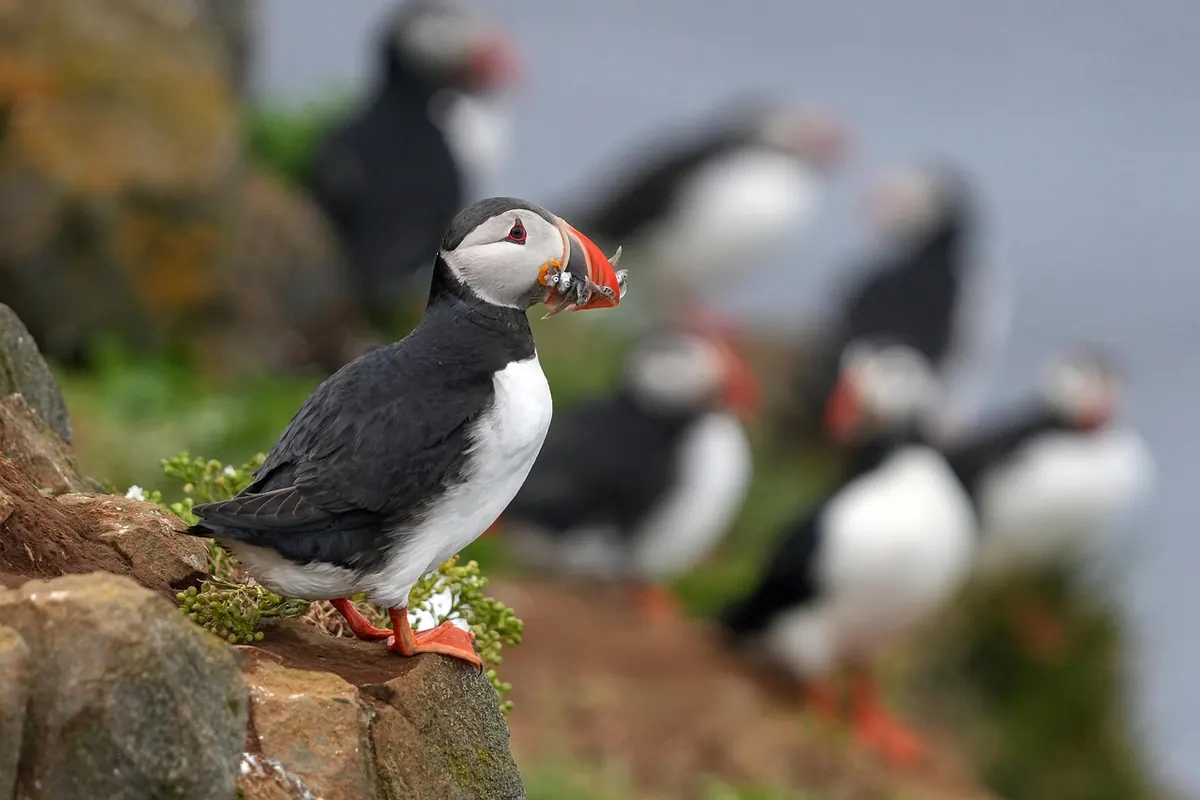
Unmistakable in summer: small, black and white, with orange legs and a brightly coloured bill. They potter about outside burrows, fly with a comic whirr, and in winter the bill turns dull and grey.
In Scotland, Ireland and the Isle of Man, watch for black guillemots: entirely black with a bold white wing patch and bright red feet, usually seen singly close inshore.
These two are long, dark and sinuous, swim low in the water with only the head and neck showing, and dive with a smooth forward roll. They often perch on rocks or harbour posts with their wings spread out to dry.
The cormorant is the larger, heavier bird, with a thick neck, a hooked bill and a patch of bare yellowish-white skin at the base of the bill and throat. The shag is slimmer, with a thinner neck, a smaller head and a yellow patch at the base of the bill; in spring it grows a curly crest. Shags are more strictly coastal, and their flight is faster and more urgent.
Gannets are big and dramatic. Adults are white with black wingtips and a soft yellowish head, with a long dagger of a bill, and they fold their wings and plunge into the sea from a height. Even at distance, that dive gives them away. Young birds are dark and speckled.
Fulmars look like stout grey-and-white gulls but fly on stiff, straight wings, alternating glides with quick flaps, and have a tube-shaped nostril on top of the bill. Manx shearwaters are dark above and white below, skimming the waves on rigid wings, and you will usually see them from a headland in the evening or from a boat rather than close to shore.
On the beach and rocks, look for oystercatchers — black and white, with a long orange bill and pink legs, and a piercing piping call. Curlews are large brown waders with a long downcurved bill. Turnstones scurry about the tideline in black, white and orange-brown, while ringed plovers are small, pale and quick, with an orange leg and a black band across the chest.
Terns are the elegant ones: slim, grey and white, hovering over the water before dropping in. Arctic terns have a red bill and long tail streamers; Sandwich terns have a black bill with a yellow tip. Eiders, the heavy sea ducks of northern coasts, are worth learning too — males are black and white with a pale green patch on the neck.
Learn a few calls and you will identify birds you never manage to see properly. Kittiwakes shout their name. Oystercatchers pipe. Curlews bubble and rise in a way that defines a British estuary. Shags grunt, cormorants grunt lower, and puffins growl from inside their burrows. Even a fuzzy recording on a phone can help you check a memory later.
Pick one or two species per trip and learn them properly rather than trying to tick everything. A simple approach works well:
Please give nesting birds room. Stay back from cliff edges and colony boundaries, keep dogs on a lead where birds are breeding, and move on quickly if birds start alarm-calling or circling. On many island coasts, disturbance is the biggest threat these birds face, and a quiet, distant observer sees far more than a close one.
Finally, be patient with yourself. Seabird identification is a skill built over seasons, not afternoons, and every coastal walk adds something. Start with the shape of a bird, add one detail, and let the rest wait until next time.
Photo: makabera / Pixabay