Scotland's islands are perfectly possible without a car. The trick is to accept that island transport runs on island time. Buses are timed around school runs and the morning ferry, not around a visitor's wish list, and that shapes everything: where you sleep, when you eat, how far you walk. Get the order of planning right — ferry first, then a bed, then the buses — and a week on foot becomes straightforward rather than stressful.
Not every island is equally kind to someone arriving on foot. Before you fall for a photograph, look at three things: how long the crossing is, whether the main settlement sits at the pier, and how far the bus network actually reaches.
Arran is the easy introduction. The ferry from Ardrossan lands you at Brodick, the buses run around the coast to Lamlash, Whiting Bay, Blackwaterfoot and Lochranza, and the villages are strung along a road you can also walk. Mull is another good one: Craignure to Tobermory by bus, then out to Fionnphort for the short foot ferry to Iona. Islay's buses connect Port Ellen, Bowmore and Port Askaig well enough for a distillery-and-beach week. The Small Isles — Eigg, Muck, Rum and Canna — suit anyone who wants a week measured in miles rather than timetables, because almost everything is walkable from the pier. Lewis and Harris work too, though buses thin out considerably in the south of Harris.
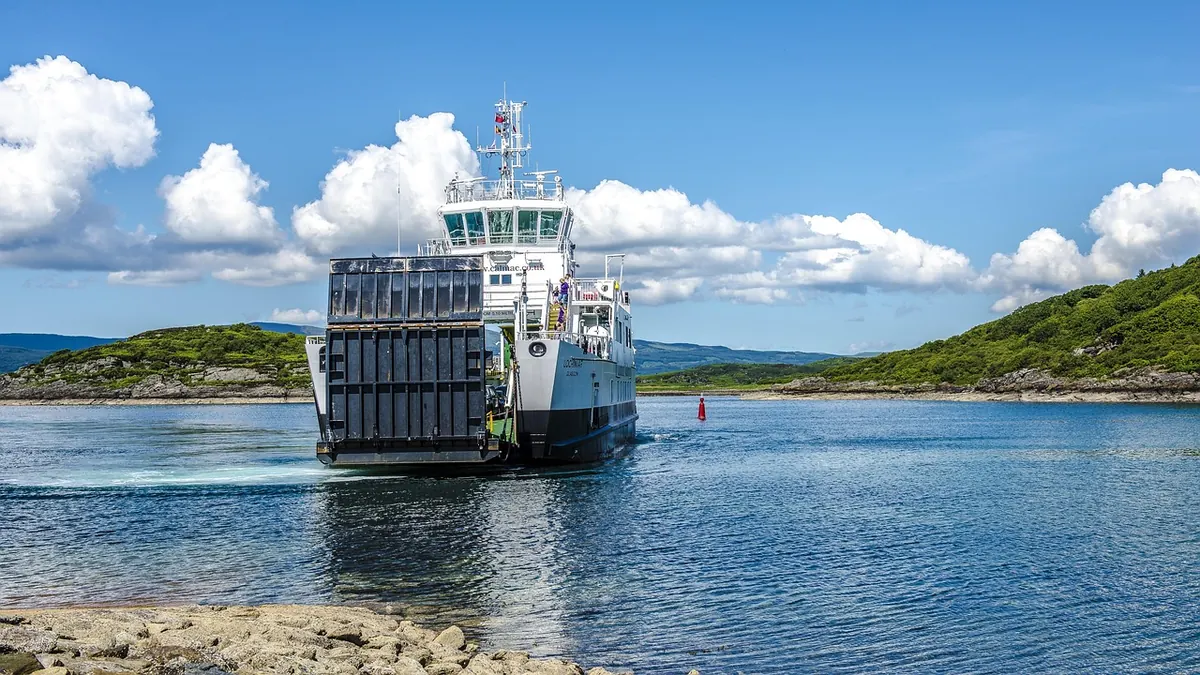
CalMac covers most of the west coast and the Hebrides; NorthLink and a few smaller operators handle Orkney and Shetland. As a foot passenger you often don't need to book at all — but do it anyway for summer sailings, for the Small Isles, and for anything on a Friday or Sunday. It costs nothing to hold a space, and it stops a week unravelling.
Two habits are worth adopting. First, book your return leg at the same time and check the sailing time twice; timetables change with the season and with maintenance. Second, treat a ferry day as a whole day. Don't book a train home from Oban for the afternoon of the same day your ferry is due in, especially in winter, when weather cancellations are a normal part of island life rather than an emergency.
If you're island-hopping, ask about the multi-island or hopscotch-style tickets, which stitch several crossings into one fare and save a surprising amount of money.
This is where most car-free plans fall apart, so do it properly. Download the timetable PDF before you book accommodation, and read it as a resident would: note the first bus, the last bus, the school-day variations, and whether there's a Sunday service. Some islands still have none, others have a limited one. Never assume, and never build a plan around a connection of less than fifteen minutes.
Bike hire is the other quiet weapon. Even a half-day's rental triples the distance you can cover and gets you to the beach the bus doesn't serve.
On an island, distances lie. A two-mile walk to the shop on a single-track road with no pavement takes longer than the map suggests, especially with a rucksack and a headwind. Walk facing oncoming traffic, step into a passing place to let cars by, and wave; island drivers are patient, but blind bends are not.
Long-distance routes make the car-free week feel deliberate rather than improvised. The Arran Coastal Way loops the whole island and connects neatly with buses and the ferry. The Hebridean Way strings together islands along the Outer Hebrides using causeways, ferries and bikes as well as boots.
Tell someone where you're going and when you expect to be back. Phone signal disappears in exactly the places worth walking.
Take a paper map or a downloaded one, waterproofs in every season, and midge protection from late spring to early autumn. The Scottish Outdoor Access Code gives you the right to walk almost anywhere responsibly, but it also asks you to close gates, keep dogs under control and give livestock room.
Island beds are finite, and July and August fill up months in advance. Options, roughly in order of affordability: Hostelling Scotland hostels and independent bunkhouses, campsites, B&Bs and guesthouses, self-catering cottages. Several places have minimum stays or Saturday changeovers in high season, so read the small print before you pay a deposit — and check the cancellation terms, because ferry disruption happens.
For the first and last night, book somewhere walkable from the pier. It removes the only genuinely awkward bit of the week. Wild camping is permitted in most of Scotland under access rights if you follow the Outdoor Access Code: small numbers, one or two nights, leave no trace, never in an enclosed field and never in someone's garden. Check for local restrictions before you pitch, and use a campsite when you want a shower and a socket.
That's six nights, one ferry, a handful of bus fares and a lot of walking. It also leaves room for the best island habit of all: changing the plan because someone in the shop said there's a better beach along that way.
Confirm your sailings, screenshot the bus timetables, ring the taxi firm if you'll need one, tell your accommodation roughly when you'll arrive, and pack lighter than you think — you're carrying everything between stops. Add a small contingency to your budget for a taxi or an extra night if the weather turns, and check what your travel insurance actually covers for ferry cancellations before you rely on it. Money and insurance decisions are worth a word with a qualified adviser if your trip is expensive or complicated.
Then stop planning. The whole point of leaving the car behind is that the week slows to the pace of the ferry, and the island is very good at filling the gaps.
Photo: Rogers-Fotodesign / Pixabay